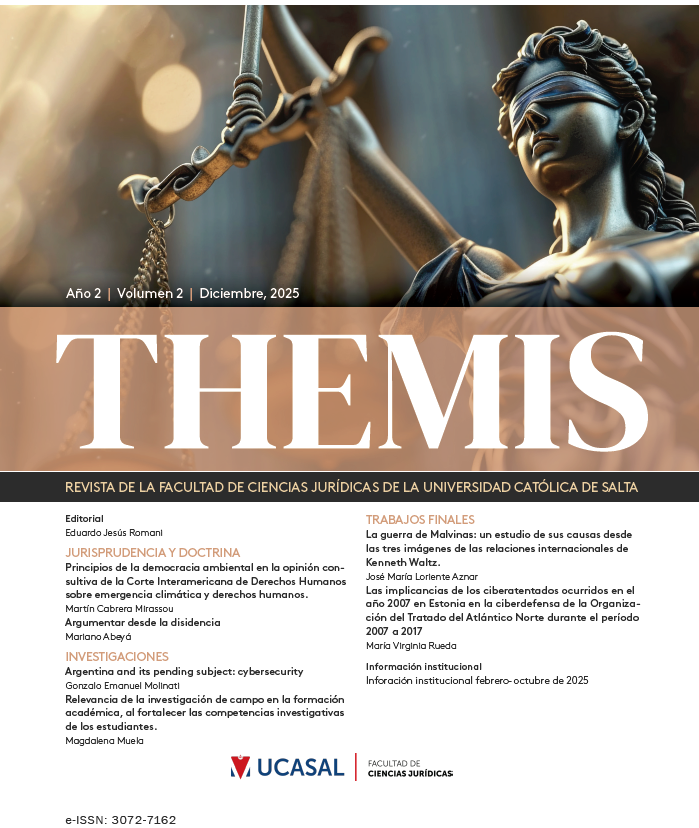
Argentina and its pending subject: cybersecurity
Abstract
This paper analyzes how the rapid advancement of technology has generated new forms of criminality that go beyond the scope of the Argentine Criminal Code, revealing critical regulatory gaps. Through concrete cases and up-to-date statistics, it exposes the insufficiency of the current legal framework, the lack of preparedness, and the weakness of public policies. It also addresses the complex debate surrounding anonymity in digital networks, defending its relevance as an essential democratic guarantee for the protection of freedom of expression, especially in contexts of vulnerability and political dissent. It warns that simplistic attempts to eliminate anonymity may have negative consequences for fundamental rights.
The paper argues that criminal law must be reformed to meet the challenges of digital crime through dynamic legislation, strengthened institutions, international cooperation, and sustained public policies. However, the approach is taken from the field of criminal law and criminal policy, without aiming to cover the technical aspects specific to computer science or cybersecurity.
The sources used—normative, jurisprudential, doctrinal, and journalistic—come from public documents, reputable media outlets, academic publications, and official records.
Downloads
References
Argentina.gob.ar. (2025). ¿Qué es el doxing y cómo podemos cuidarnos?
Brodersen, J. (2025). Hackeos al Estado: avances, críticas y qué dicen en la Agencia Federal de Ciberseguridad sobre la estrategia nacional. Brodersen Darknews. https://www.brodersendarknews.com/p/hackeos-al-estado-criticas-afc-cert-dnc
Cámara de Apelaciones en lo Criminal y Correccional de la Ciudad Autónoma de Buenos Aires, Sala I. (2021). Causa n. º 41459/2019-3 [Fallo]. https://pupilacdn.nyc3.cdn.digitaloceanspaces.com/diariojudicial.public/documentos/000/099/168/000099168.pdf
Check Point Research. (2023, citado por iProUP). Ciberataques: Argentina sufrió 2.052 ataques semanales en promedio. iProUP. https://www.iproup.com/innovacion/39852-ciberataques-argentina-sufrio-2052-ataques-semanales-en-promedio
Corte Suprema de Justicia de la Nación. (1992). Servini de Cubría, María Romilda s/ amparo (S. 303-S. 292) [Fallo]. https://www.saij.gob.ar/corte-suprema-justicia-nacion-federal-ciudad-autonoma-buenos-aires-servini-cubria-maria-romilda-amparo-303-292-fa92001426-1992-09-08/123456789-624-1002-9ots-eupmocsollaf
Cybersecurity Ventures. (2024). Cybercrime to cost the world $9 trillion annually in 2024. https://cybersecurityventures.com/cybercrime-to-cost-the-world-9-trillion-annually-in-2024/
Derechos Digitales. (2024). Ciberseguridad en América Latina: Estrategias nacionales en 2024. https://www.derechosdigitales.org/wp-content/uploads/DD_CYRILLA_ESP_2024.pdf
Grenni, L., & Fernández Ríos, R. (2018). La previsión normativa del tipo penal de grooming en la Argentina. En R. A. Parada & J. D. Errecaborde (Eds.), Cibercrimen y delitos informáticos: Los nuevos tipos penales en la era de Internet (pp. 101–120). Erreius.
IBM. (2024). ¿Qué es la ciberseguridad? https://www.ibm.com/es-es/topics/cybersecurity
Juzgado Federal N.º 1 de la Ciudad Autónoma de Buenos Aires. (2020). Causa Gaspar Ariel Ortmann: sobreseimiento [Fallo]. https://drive.google.com/file/d/16KNmhbhOrA52ucEZ6z3i62_JvEq7O3_h/view
La Nación. (2020). Hackeó el Home Banking, compró dólares a menor precio y fue sobreseído. https://www.lanacion.com.ar/sociedad/hackeo-home-banking-compro-dolares-menor-precio-nid2526938/
Meaños, F. (2023, junio 28). Ciberataque a la CNV: no se pagó el rescate y los hackers liberaron información sensible sobre el mercado. Infobae. https://www.infobae.com/economia/2023/06/28/ciberataque-a-la-cnv-no-se-pago-el-rescate-y-los-hackers-liberaron-informacion-sensible-sobre-el-mercado/
Mount Vernon Ladies’ Association. (s.f.). The Federalist Papers. Mount Vernon. https://www.mountvernon.org/library/digitalhistory/digital-encyclopedia/article/federalist-papers
Organización de las Naciones Unidas. (1948). Declaración Universal de Derechos Humanos. https://www.un.org/es/about-us/universal-declaration-of-human-rights#:~:text=Art%C3%ADculo%2019,por%20cualquier%20medio%20de%20expresi%C3%B3n
Parlamento Europeo y Consejo de la Unión Europea. (2022). Directiva (UE) 2022/2555 del Parlamento Europeo y del Consejo de 14 de diciembre de 2022 relativa a medidas para un elevado nivel común de ciberseguridad en toda la Unión (Directiva NIS 2). https://eur-lex.europa.eu/legal-content/EN/TXT/?uri=CELEX:32022L2555
Procuración General de la Nación. (2016). Guía de obtención, preservación y tratamiento de evidencia digital [PDF]. https://www.fiscales.gob.ar/wp-content/uploads/2016/04/PGN-0756-2016-001.pdf
Suárez, L. [@derechoinformatico]. (2025). Informe sin HASH [Publicación de Instagram]. Instagram. https://www.instagram.com/p/DLP_DxHRAOg/
Temperini, M. (2018). Delitos informáticos y cibercrimen: Alcances, conceptos y características. En R. A. Parada & J. D. Errecaborde (Eds.), Cibercrimen y delitos informáticos: Los nuevos tipos penales en la era de internet (pp. 33–48). Erreius.
Unidad Fiscal Especializada en Ciberdelincuencia [UFECI]. (2023). Informe de gestión de la Unidad Fiscal Especializada en Ciberdelincuencia 2022–2023. https://www.fiscales.gob.ar/wp-content/uploads/2023/12/UFECI_informe-de-Gestion_23_15-12.pdf
Unidad de Información Oficial. (2025). Plan Federal de Prevención de Ciberdelitos y Gestión Estratégica de la Ciberseguridad 2025–2027 (Resolución 72/2025). https://drive.google.com/file/d/1-iGV_3CkIhjz6yf7hZwXiOQDoXlgl5ea/view
Copyright (c) 2025 Themis

This work is licensed under a Creative Commons Attribution-NonCommercial-ShareAlike 4.0 International License.